
 ~5 MIN
Intro
The biggest takeaway from recent Blizzard commentary is simple:
The next 30 years of Diablo won’t look like the last 30.
Over three decades, the franchise produced:
- Diablo I
- Diablo II
- Diablo III
- Diablo Immortal
- Diablo IV
Five core titles in 30 years.
Blizzard leadership has now openly suggested they expect the future cadence to be faster. That alone changes how we should think about Diablo 4 — and the broader Diablo roadmap.
Let’s break down what this realistically means.
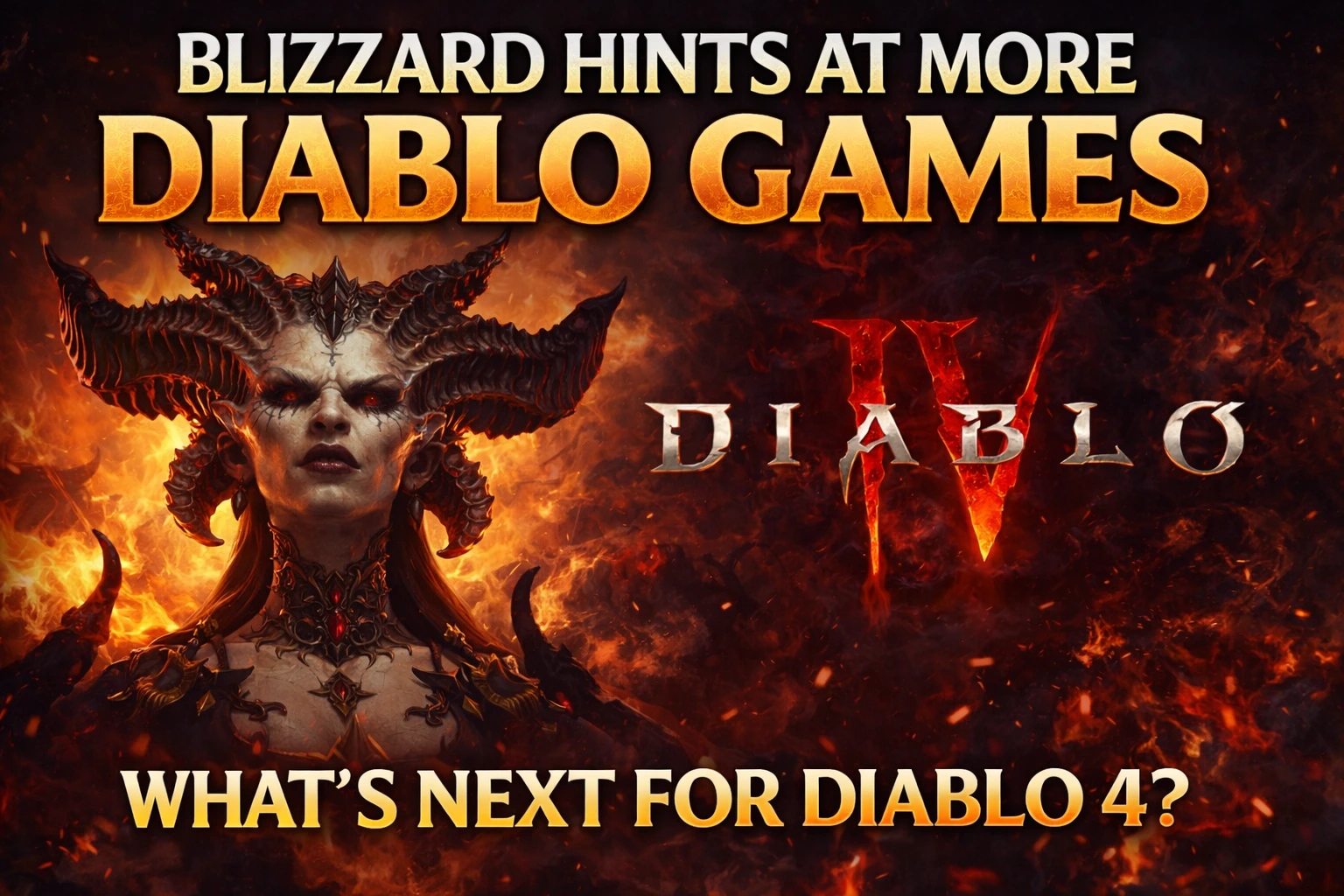

The Big Shift: Faster Diablo Releases
Historically, Diablo releases have been spaced far apart:
- Diablo II → Diablo III: 12 years
- Diablo III → Diablo IV: 11 years
That era is over.
Modern Blizzard operates differently:
- Live-service models
- Seasonal frameworks
- Expansions as structured progression
- Multi-team development
The implication is clear:
Diablo is no longer a once-a-decade franchise.
It’s becoming a platform.
What Could Be Coming Next?
There are three realistic scenarios:
1️⃣ A Diablo IV Expansion Announcement
This is the safest bet.
Even with Lord of Hatred launching, by the time BlizzCon arrives, we’ll already be months deep into its lifecycle. Historically, Blizzard does not let expansion momentum cool before teasing the next phase.
Expansion III is extremely likely.
And that raises the real question:
Where do we go next?
Possible Expansion Settings
The Diablo universe still has massive unexplored regions.
Here are the strongest candidates:
Isle of Xiansai
An Asian-inspired aesthetic — architecturally and culturally distinct from what Diablo has done so far.
Fresh visual identity.
New enemy archetypes.
Completely new biome language.
Westmarch Revisited
After Malthael’s devastation in Diablo III, we never truly explored long-term recovery.
A gothic city biome expansion could:
- Deliver strong vertical design
- Introduce urban dungeon mechanics
- Expand political conflict themes
Mount Arreat and The Worldstone Aftermath
The destruction of the Worldstone reshaped Sanctuary. Revisiting Ariat Crater could:
- Tie directly into Diablo II nostalgia
- Explore the world’s magical instability
- Provide lore-driven escalation
Each option has strong thematic weight.
What About a Diablo I Remake?
When leadership references “more Diablo games,” that does not automatically mean Diablo V.
It could mean:
- A Diablo I remake
- A side-project spin-off
- A smaller-scale experimental ARPG
- A mobile companion title
The Diablo I remake theory is particularly strong.
Why?
- Diablo II Resurrected proved remasters sell
- Nostalgia is high
- Diablo I’s atmosphere is still unmatched
A modern remake using Diablo IV’s engine could be a powerful move.
Diablo IV Expansion III – What Should It Focus On?
If Expansion III is coming, it must address long-term player retention.
The key pillars:
🔥 Endgame Depth
Nightmare Dungeons and The Pit are solid foundations — but expansion-level content must evolve the system.
True endgame replayability requires:
- Meaningful build branching
- Unique boss mechanics
- Economy-driven chase systems
If you’re already pushing high-end content and optimizing builds, structured progression through the Diablo High Tier Bundle can dramatically accelerate your climb.
Economy Stability
Expansion launches create huge currency volatility.
Gold becomes critical for:
- Enchants
- Respecs
- Masterworking
- Crafting experiments
Preparation matters. Securing sufficient Diablo Gold Coins before expansion cycles helps eliminate early-season friction.
Seasonal Integration
The seasonal model is now Diablo’s core content engine.
Each expansion must:
- Integrate seasonal mechanics seamlessly
- Avoid feature bloat
- Preserve build clarity
The danger isn’t lack of content.
It’s overcomplication.
Diablo II Act VI – A Dangerous Possibility
Another topic gaining traction is the possibility of a new Act in Diablo II.
On paper? Incredible.
In practice? Extremely difficult.
Adding Act VI would require:
- New biomes
- New questline
- New Act boss
- Lore continuity alignment
The biggest problem:
Any new act risks retconning established lore between Diablo II and Diablo III.
Even Diablo Immortal already stretched the narrative bridge.
If Act VI happens, it must:
- Avoid contradicting established canon
- Introduce a contained regional conflict
- Respect future timeline consistency
This is not easy.
The Bigger Picture: Diablo as a Multi-Project Franchise
The most important development isn’t a single expansion.
It’s this:
Blizzard is positioning Diablo as a faster-moving, multi-project ecosystem.
That means:
- Parallel development teams
- Smaller experimental releases
- Faster expansion cadence
- Potential cross-media growth
The franchise is no longer dependent on one massive tentpole release every decade.
It’s evolving into a continuous content engine.
What Should Players Do Now?
If Diablo content velocity increases, player preparation becomes more important.
Especially during expansion transitions.
✔ Optimize Your Build
Higher Torment tiers demand precision scaling.
Advanced tuning and resource management matter more than ever.
✔ Prepare Leveling Efficiency
Expansion launches reward early momentum.
Efficient leveling paths can define your first month of progress.
If you’re planning to swap classes or push hard on launch, structured Diablo Leveling Boost can remove the early grind barrier.
✔ Master Nightmare Scaling
Nightmare Dungeons remain one of the strongest endgame progression pillars.
Targeted runs through Diablo Nightmare Dungeons remain a highly efficient path to glyph optimization.
Final Coaching Take
Here’s the key shift:
Diablo is no longer a static franchise.
It’s accelerating.
More expansions.
More titles.
More experimental formats.
Faster release cadence.
That changes how you approach the game.
- Stay flexible with builds.
- Prepare for economic spikes.
- Expect faster meta shifts.
- Think long-term, not seasonal-only.
The next 30 years of Diablo will not mirror the last 30.
And if Blizzard follows through on this trajectory, Diablo 4 may just be the foundation — not the peak.