

Content:
- Intro
- The Warlock – Diablo IV’s New Class Finally Revealed
- Lord of Hatred – New Expansion, New Direction
- Warplans – The New Endgame System
- Echoing Hatred – A New Bossing Framework
- The Skill Tree Overhaul – Subtle but Foundational
- Talismans – Expanding Customization
- What This Means for Season Structure
- The Bigger Picture – Diablo IV’s Direction Is Clear
Intro
Blizzard’s 30th Anniversary Diablo Spotlight wasn’t just a celebration — it was a roadmap.
For Diablo IV players, this event confirmed what many suspected: the next phase of the game isn’t incremental. It’s structural. A new class, a new zone, a new endgame framework, and a fundamental skill tree evolution are all arriving with Lord of Hatred.
Let’s break down exactly what was revealed — and what it means for serious players preparing for the next era of Diablo IV.

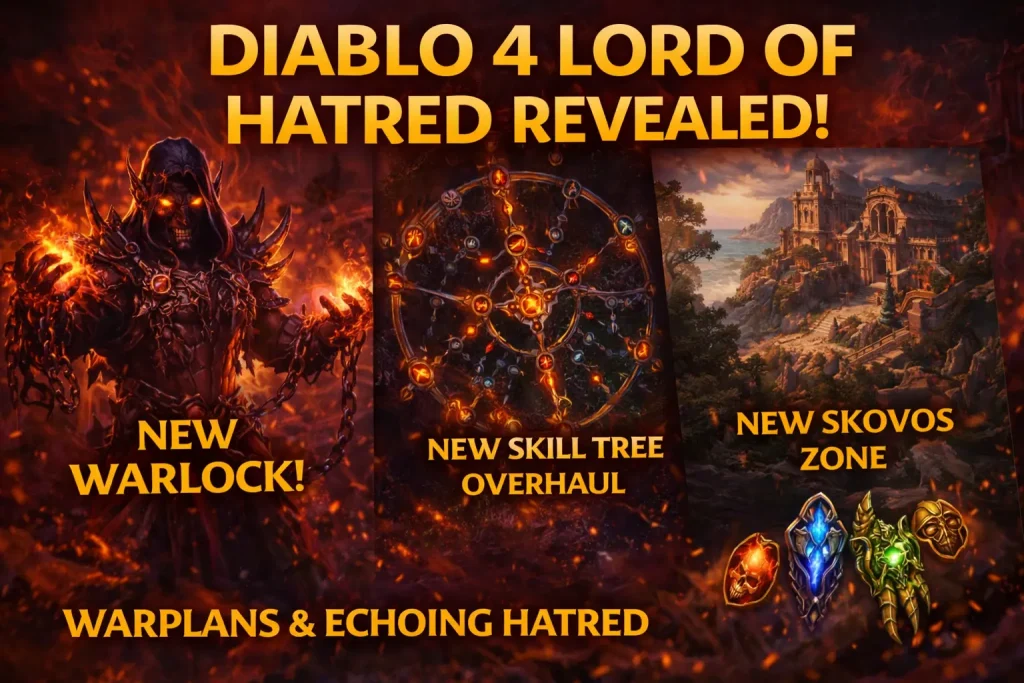
The Warlock – Diablo IV’s New Class Finally Revealed
The headline announcement is clear:
The Warlock is coming to Diablo IV.
This class embodies the darker side of Sanctuary’s magic. Unlike Necromancer’s corpse-based summoning or Sorcerer’s elemental focus, the Warlock leans into forbidden pacts, blood rituals, and infernal contracts.
What Defines the Warlock?
From the reveal, we know:
- The Warlock channels demonic forces through pact systems.
- Resource manipulation appears central to its gameplay.
- It likely blends mid-range spellcasting with summoned or bound entities.
- Visual themes emphasize corruption, ritual magic, and shadow energy.
This is not a simple variation of existing archetypes — it fills a fantasy gap Diablo IV hasn’t addressed yet.
For players planning to experiment heavily on release, early flexibility matters. Having access to stable currency like Diablo Gold Coins makes adjusting builds and gear far smoother when entirely new mechanics land.
Lord of Hatred – New Expansion, New Direction
The Warlock arrives with the Lord of Hatred expansion, which introduces:
- A brand-new region: Skovos
- A new progression philosophy
- A fresh endgame structure
Skovos appears darker and more ritualistic than previous zones. It leans heavily into cult influence, corrupted lands, and thematic tension tied directly to Mephisto’s growing power.
But the environment is only part of the change.
Warplans – The New Endgame System
The most important systemic reveal was Warplans.
Warplans function as curated endgame playlists:
- Structured challenge rotations
- Targeted reward paths
- Replayable, escalating difficulty tiers
This shifts endgame away from purely random dungeon repetition toward intentional progression tracks.
For serious grinders, that means:
- More predictable farming
- Strategic route planning
- Clear reward optimization
Players pushing efficiency often pair structured content with tools like Diablo Leveling Boost to stay ahead of seasonal pacing.
Echoing Hatred – A New Bossing Framework
Another major reveal was Echoing Hatred.
While details remain limited, this appears to be:
- A scalable boss system
- A repeatable high-difficulty challenge
- Likely tied to exclusive reward brackets
Think of it as Diablo IV’s next step in creating repeatable aspirational PvE content.
This is a direct response to feedback that current pinnacle encounters lack long-term replay value.
The Skill Tree Overhaul – Subtle but Foundational
Blizzard confirmed a meaningful evolution of the Diablo IV skill tree.
While not a complete rebuild, the changes aim to:
- Deepen specialization options
- Improve build identity clarity
- Reduce “mandatory node” traps
- Open hybrid archetype paths
The skill tree is not being simplified — it’s being made more expressive.
For theorycrafters, this is huge.
Whenever large-scale rebalancing hits, build optimization becomes critical. Players refining high-end setups often use services like Diablo High-Tier Bundle to quickly test endgame viability without weeks of trial-and-error farming.
Talismans – Expanding Customization
Another system previewed during the spotlight was Talismans.
Talismans appear to:
- Modify ability behaviors
- Enhance build archetypes
- Add conditional mechanics
- Potentially act as build-defining modifiers
If implemented correctly, this system could dramatically increase:
- Mid-season experimentation
- Build diversity
- Long-term replayability
This pushes Diablo IV closer to a system-driven ARPG rather than a static seasonal loop.
What This Means for Season Structure
The timing of this spotlight clarifies something important:
Recent seasons have felt transitional because they were.
Blizzard is clearly positioning:
- Season content as bridge mechanics
- Expansion systems as the long-term vision
- Lord of Hatred as the structural reset point
This is not filler — it’s staging.
The Bigger Picture – Diablo IV’s Direction Is Clear
Looking at everything together:
- A new class that fills a dark fantasy gap
- A structured endgame via Warplans
- Scalable boss challenges through Echoing Hatred
- A deeper skill tree system
- Talismans adding modular customization
This is Blizzard moving Diablo IV from reactive balancing to proactive system design.
Instead of chasing seasonal gimmicks, they’re building frameworks meant to last.
Final Thoughts – The Real Reset Is Coming
The 30th Anniversary Spotlight wasn’t flashy — it was decisive.
Warlock isn’t just another class.
Warplans aren’t just another activity.
The skill tree evolution isn’t cosmetic.
Lord of Hatred represents Diablo IV’s first true structural expansion — one that reshapes how players engage with builds, endgame loops, and long-term progression.
If you stepped away from Diablo IV waiting for a turning point, this is likely it.
And if you plan to return when Warlock launches, preparing now — economically and structurally — will matter more than ever.