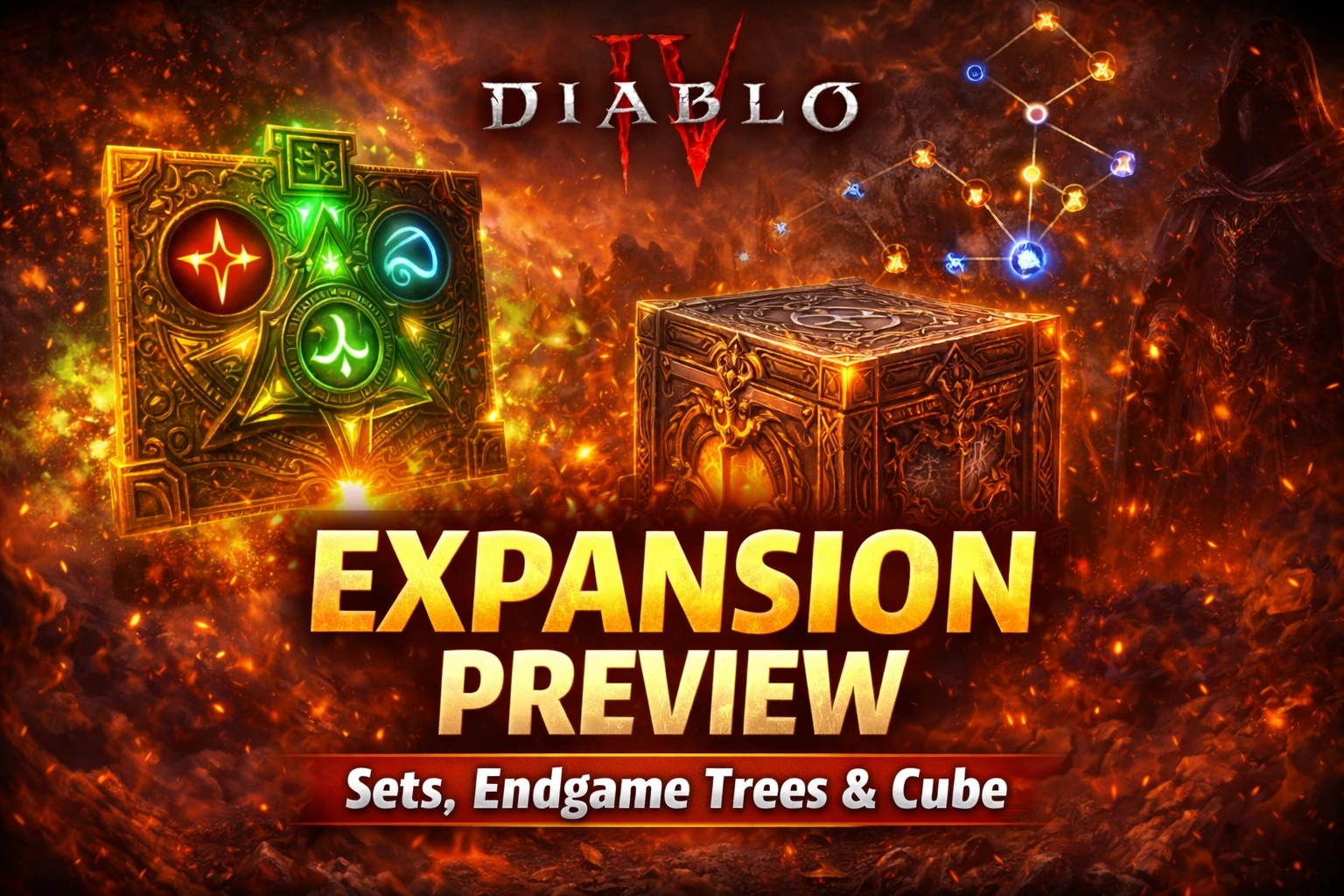
Sets Confirmed, New Endgame Trees, Horadric Cube Crafting and Infinite Progression
Blizzard has started revealing major systems coming with the next Diablo IV expansion, and the scope is far larger than many expected. We’re not just looking at balance tweaks or seasonal mechanics—this is a fundamental overhaul of endgame progression, itemization, and build customization.
From confirmed set bonuses and content-specific skill trees, to Horadric Cube crafting and a reworked endgame map, here’s a complete breakdown of what’s coming and how it all fits together.


Set Bonuses Are Officially Confirmed (But Not How You Expect)
Set bonuses are coming to Diablo IV—but not in the traditional item-slot format.
Instead of equipping full armor sets (helm, chest, boots, etc.), set bonuses are activated through a Talisman system.
How it works:
- You socket specific runes into a Talisman
- Correct rune combinations activate set bonuses
- A “set” is defined by the combination itself—not by armor slots
This means:
- Sets are more flexible than traditional gear sets
- Bonuses can be triggered through non-armor items
- Multiple set combinations are expected to exist
In short: Talismans = Sets, and set bonuses are no longer tied to fixed gear pieces.
A Completely Reworked Endgame Map
The expansion introduces a centralized endgame board, unlocked after completing the campaign.
From this board, players will:
- Select which endgame content to farm
- See available activities in the current rotation
- Track progress toward rewards using a visible progress bar
Confirmed endgame activities shown:
- Infernal Hordes
- Nightmare Dungeons
- Helltide
- Boss Lairs
- Bounties / Assignments
Each activity:
- Has its own reward track
- Contributes to progression independently
- Can be chosen based on what rewards you want right now
This replaces the current “do everything randomly” approach with intentional farming paths.
Content-Specific Skill Trees (Endgame Trees)
One of the biggest changes is the introduction of separate skill trees tied to endgame content.
How these trees work:
- Each endgame activity has its own tree
- Trees apply modifiers to that content
- Modifiers make content harder but more rewarding
Examples:
- Stronger enemies
- Additional debuffs on the player
- Increased difficulty scaling
In return:
- Higher loot output
- Better rewards
- More targeted farming
This system closely resembles:
- Atlas trees (Path of Exile)
- Mission boards (Wolcen)
The result is true player choice in how difficulty and rewards scale.
Why This Adds Real Build Variety
Unlike simple buffs, these trees introduce risk vs reward decisions.
You’ll decide:
- Do you want more survivability?
- More damage?
- Faster clears?
- Higher resource generation?
At first, you’ll unlock only part of a tree—forcing real choices. Over time, more nodes become available, but early progression still matters.
This avoids the “everything unlocked instantly” problem and adds strategic planning to endgame.
Horadric Cube Is Back (With a New Role)
The Horadric Cube returns, but it’s not just a nostalgic feature.
In Diablo IV, the Cube:
- Applies special properties to items
- Uses recipes to modify gear
- Replaces some functions of current crafting systems
Unlike Diablo III (where the Cube mostly adjusted stats), the Diablo IV Cube interacts with runes and rune recipes.
Key details:
- Runes orbit items during Cube interactions
- Runes can enhance items directly
- Runes are both build-defining and crafting components
This means crafting becomes:
- More modular
- More experimental
- More tied to build identity
Runes: From Build Mechanics to Item Enhancement
Runes are no longer just passive bonuses.
They now:
- Enable set bonuses via Talismans
- Act as crafting ingredients in the Cube
- Add additional properties to weapons and gear
While exact recipes aren’t revealed yet, the system suggests:
- Certain rune combinations unlock unique effects
- Effects can be applied either via sockets or Cube crafting
- Item power is no longer purely stat-based
This significantly deepens item progression.
A New Hero Class Is Teased
Blizzard hints at a second new class, described as a “dark silhouette”.
Important clues:
- Paladin is already available
- The next class is described as “dark”
- The description strongly fits a Warlock-style class
While not officially confirmed, the language strongly implies:
- Shadow-based mechanics
- Dark magic themes
- Possibly minions, curses, or demonic interactions
This aligns naturally with the new rune and Cube systems.
Why Season 11 Feels Like a Beta Test
Many mechanics from Season 11 now clearly resemble prototypes:
- Random item enhancements
- Risk/reward mechanics
- Temporary debuffs for power
These systems appear to be early testing grounds for expansion features that will become permanent and more structured.
This explains:
- Why Season 11 feels experimental
- Why many systems feel “unfinished”
- Why the expansion systems feel like natural evolutions
What This Means for Players Right Now
If you’re actively playing Diablo IV:
- Resource management matters more than ever
- Preparing multiple builds will be valuable
- Gold and crafting materials will remain critical
Keeping a stable economy helps smooth future transitions, especially with crafting-heavy systems. For that reason, Diablo Gold Coins remain essential for rerolls, upgrades, and Cube experimentation.
Players planning to try multiple classes or prepare for the expansion may benefit from Diablo Leveling Boost to reduce setup time.
For endgame-focused players, consolidating gear and resources early through a Diablo High Tier Bundle can remove friction once the new systems go live.
Final Thoughts
This Diablo IV expansion is shaping up to be the most ambitious update since launch.
Confirmed highlights:
- Set bonuses return via Talismans
- Infinite-feeling endgame map
- Content-specific skill trees
- Horadric Cube crafting
- Runes as both build and crafting mechanics
- A new hero class on the horizon
Most importantly, these systems finally give players control over how they farm, how they scale difficulty, and how they shape their builds—something Diablo IV has been missing.
If Blizzard executes this cleanly, Diablo IV’s endgame may finally reach the depth players have been asking for.

 ~5 MIN