

Content:
- Intro
- A New Philosophy in RPG Design
- Core Gameplay Loop
- Heroes and Roles
- Combat Depth and Momentum
- Progression and Customization
- Art Direction and Atmosphere
- Sound Design and Immersion
- Social Features and Replayability
- Performance and Platforms
- Verdict — Small Studio, Big Ambition
- FAQ — Fellowship (2025)
Intro
In a year filled with high-budget open-world RPGs and survival clones, Fellowship stands out by going in the opposite direction — focusing instead on intimacy, team play, and repeatable cooperative challenges.
Developed by Chief Rebel in collaboration with Ark Games, Fellowship blends the accessible structure of an MMO with the intensity of tactical PvE combat. The result feels like a hybrid between Diablo IV, Deep Rock Galactic, and Genshin Impact — but with an indie-driven soul and a far stronger emphasis on collaboration.

A New Philosophy in RPG Design
At its core, Fellowship isn’t trying to be a never-ending world — it’s trying to be a living system.
Instead of pushing players through endless maps and convoluted quest chains, the game is built around short, replayable adventures designed to be played in teams of two to four players. Each session plays out like a focused narrative arc with tight combat pacing, light puzzle solving, and procedural elements that keep repetition minimal.
The developers describe their goal as “returning to the campfire” — creating that nostalgic, tabletop-like rhythm where players rely on teamwork and communication rather than raw stats.
Core Gameplay Loop
Each run begins in a shared hub zone, where you and your party select contracts, upgrade gear, and manage your heroes’ loadouts. Missions are structured across compact but detailed environments — caves, ruins, marshlands, or fractured dimensional rifts — each designed to be completed in 25–45 minutes.
Inside these missions, you’ll find:
- Dynamic encounters that scale with team composition.
- Environmental modifiers, like fog, shifting light, or cursed weather, forcing constant adaptation.
- Synergistic enemy types that require coordinated counterplay.
What separates Fellowship from typical ARPGs is that it avoids spamming abilities for numbers. Instead, it rewards positioning, combo timing, and defensive coordination. Dodging, blocking, and using the environment — like funneling enemies through narrow corridors — are just as important as DPS output.
Heroes and Roles
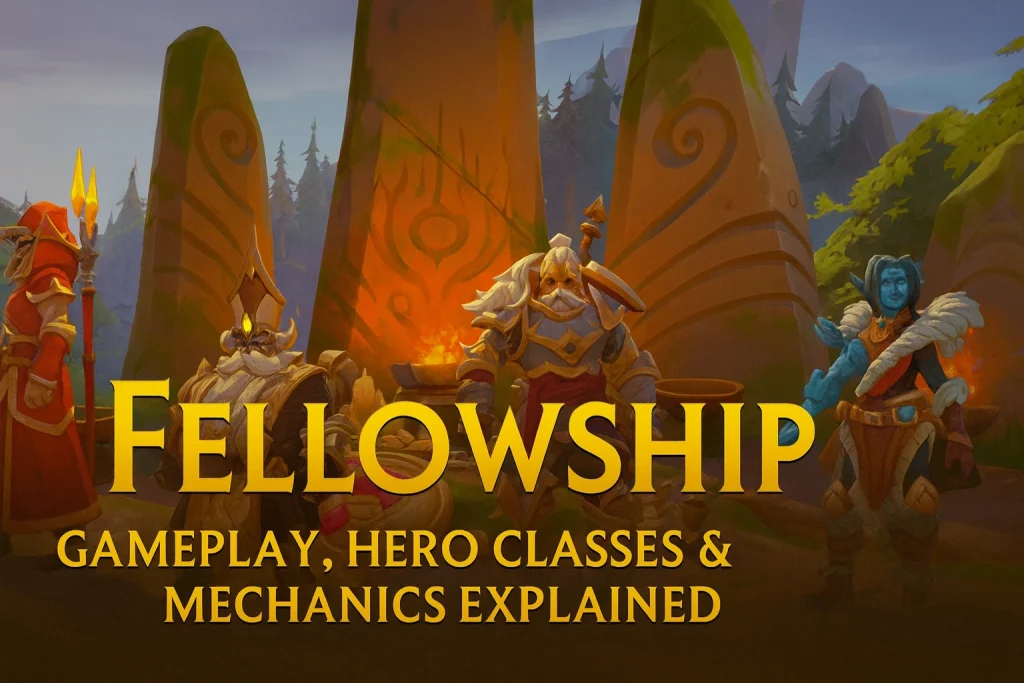
Fellowship’s playable roster is divided into distinct hero archetypes, each with flexible build paths that let players experiment without punishing them for respecs.
- The Vanguard — a frontline tank with rallying auras and shield-bash mechanics. Designed for players who like to dictate fight tempo and control enemy aggro.
- The Warden — a hybrid healer/support who manipulates terrain and buffs allies. Their area control spells are crucial for managing boss phases.
- The Arcanist — the classic high-risk, high-reward caster who channels volatile energy for massive burst damage. Proper cooldown management is essential.
- The Stalker — a mobility specialist blending stealth, traps, and precision damage. Excels at breaking boss mechanics and disrupting elite enemies.
While these categories seem traditional on paper, Fellowship’s combat system allows for overlapping synergies — meaning a Vanguard can pivot into an offensive bruiser if paired with a defensive Warden, or an Arcanist can act as a zone-denier with the right relic loadout.
Combat Depth and Momentum
Fellowship’s combat takes heavy inspiration from Soulslike fundamentals — measured, weighty animations, and stamina-based management — but integrates the momentum system, a feature entirely its own.
Each successful dodge, parry, or counter adds momentum stacks, which can be spent to trigger devastating team-based ultimate combos.
This mechanic transforms otherwise routine encounters into rhythmic duels where synergy and reflexes dictate success. The system punishes spammy behavior but rewards teams who read patterns and synchronize attacks.
Boss fights embrace this philosophy fully — huge, arena-style duels with phase transitions that demand precise coordination. A single mistake can undo minutes of progress, but executing the right sequence as a team is immensely satisfying.
Progression and Customization
Rather than grind hundreds of random drops, Fellowship uses modular gear crafting. Players collect resources and essences from missions to forge or modify existing weapons. This reduces RNG frustration and encourages mastery over time instead of luck.
Customization layers include:
- Weapon Aspects — powerful modifiers tied to enemy types or elemental interactions.
- Relic System — shared passives that can alter team play (e.g., healing pulses when allies crit).
- Skill Evolution Paths — abilities that adapt depending on your recent combat behavior, subtly personalizing playstyle.
Progression feels earned, not given, and — refreshingly — nothing is hidden behind a paywall or loot-box system. The developers confirmed that Fellowship will launch as a premium title with optional cosmetic expansions, not a free-to-play grindfest.
Art Direction and Atmosphere
Visually, Fellowship strikes a unique balance between stylized and grounded aesthetics.
The environments are painterly and rich in atmosphere, reminiscent of Ori and the Will of the Wisps but viewed through a darker, grittier lens.
Lighting and color palettes shift dynamically based on the biome — foggy greens for swamps, amber glows for ruined temples, and stark blues for crystal caverns.
Every frame feels designed for mood and readability rather than spectacle — clear silhouettes, simple spell effects, and subtle hit feedback make the action visually coherent even in chaotic battles.
Sound Design and Immersion
Audio plays a major role in situational awareness.
Weapon impacts echo differently depending on the material hit, while subtle danger tones cue players to incoming abilities. The orchestral score swells dynamically, shifting from ambient mystery during exploration to powerful tribal beats in combat — creating an emotional arc even within short sessions.
The result feels more handcrafted than algorithmic — a deliberate step away from the overstimulation of most modern action RPGs.
Social Features and Replayability
Co-op synergy is the soul of Fellowship.
Players can form guilds, join seasonal events, and take part in weekly rotating “Rifts,” which act as miniature raids with environmental handicaps.
Cross-play is planned at launch, and while the developers haven’t confirmed PvP, they’ve hinted at future friendly duel arenas to test builds competitively.
What keeps the loop exciting is adaptive mission scripting — returning to the same dungeon rarely feels identical. Enemy placements, weather, and even side objectives can change, forcing new strategies.
It’s a design that prioritizes replay value over raw size, and it works beautifully.
Performance and Platforms
Built on Unreal Engine 5, Fellowship maintains strong performance across PC and next-gen consoles.
Its technical optimization is surprisingly solid for an indie-scale project — stable frame pacing, detailed models, and no intrusive UI clutter.
The developers confirmed scalable settings for mid-tier hardware, ensuring accessibility without major downgrades.
Verdict — Small Studio, Big Ambition
Fellowship feels like the kind of project that only smaller studios can pull off — focused, uncompromising, and full of heart.
It’s not trying to outdo AAA spectacle; it’s redefining what cooperative adventure means in 2025. With its momentum-driven combat, meaningful progression, and emphasis on teamwork over solo efficiency, it’s one of the most promising new co-op RPGs in years.
Fellowship releases later this year for PC, PlayStation 5, and Xbox Series X|S, with early access planned for Steam and Epic Games Store.
FAQ — Fellowship (2025)
Q1. What is Fellowship?
Fellowship is a cooperative action RPG developed by Chief Rebel and Ark Games. It blends tactical, team-based combat with modular progression, allowing players to build customizable heroes and take on dynamic missions across handcrafted fantasy environments.
Q2. Is Fellowship an MMO?
Not exactly. Fellowship isn’t a traditional MMO — it’s closer to a session-based co-op RPG. Think of it as a hybrid between Diablo, Deep Rock Galactic, and Monster Hunter, where each mission lasts 30–45 minutes and focuses on teamwork and replayability rather than massive persistent worlds.
Q3. How many players can play together?
The game supports 2 to 4 players in cooperative multiplayer. Solo play is possible but more challenging, as many encounters and momentum-based combos are tuned for coordinated teams.
Q4. What platforms will Fellowship release on?
Fellowship is planned for PC, PlayStation 5, and Xbox Series X|S, with cross-play and cross-progression available from launch. A Steam Early Access release is expected before the full launch later in 2025.
Q5. How does the Momentum System work?
Momentum is Fellowship’s core combat mechanic. Successful dodges, parries, or team combos build momentum stacks, which can be spent to unleash devastating coordinated abilities. It’s designed to reward synchronization rather than button mashing.
Q6. Are there classes or heroes?
Yes. The game features distinct hero archetypes such as the Vanguard, Warden, Arcanist, and Stalker, each offering flexible skill paths and weapon builds. Players can mix and evolve playstyles without heavy penalties for respecs.
Q7. Is Fellowship pay-to-win?
No. The developers have confirmed that Fellowship is a premium release with optional cosmetic content only. There are no loot boxes, power boosts, or gacha systems. Progression is earned through gameplay and crafting.
Q8. How does progression work?
Players gather resources from missions to craft or enhance gear via the Relic and Aspect systems, unlocking new abilities and stat modifiers. Each hero evolves based on player behavior — meaning your build reflects your combat style.
Q9. Is there PvP or competitive mode?
PvP is not confirmed for launch, but developers have hinted at friendly duels and training arenas where players can test builds against each other in future updates.
Q10. Why is Fellowship generating buzz?
Because it prioritizes cooperative depth and replayability over scale. Its handcrafted missions, synergistic combat, and progression clarity offer a refreshing break from endless grind-heavy RPGs.