
 ~5 MIN
Playing the Entire Game Using Only Chat Commands
Final Fantasy XIV allows for incredible freedom in how players approach content. Over the years, players have completed expansions solo, restricted themselves to specific regions, or imposed extreme progression limits.
This challenge goes further than all of them.
The goal is simple to describe and brutal to execute:
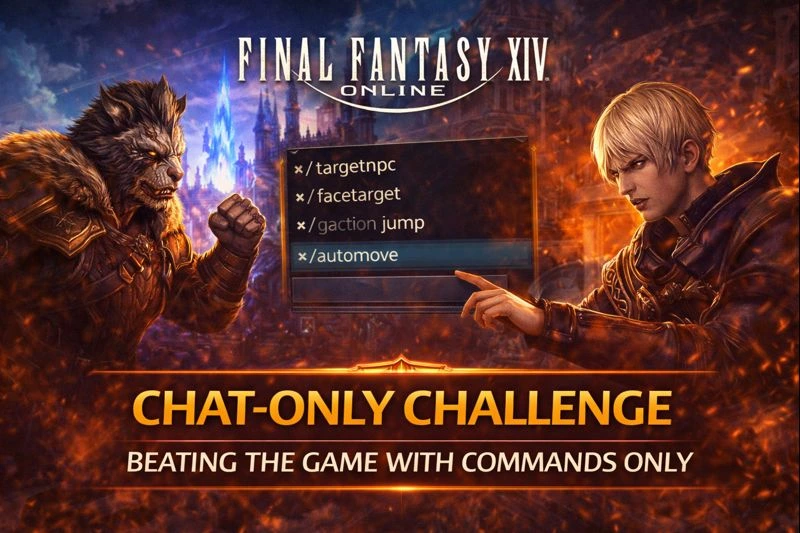
Play Final Fantasy XIV using only chat commands.
No movement keys.
No mouse clicks.
No ability buttons.
Everything—movement, targeting, interaction, combat—must be done through typed commands in chat.

The Core Rules of the Challenge
From the moment the challenge begins, the restrictions are absolute.
Allowed Actions
- Typing chat commands
- Adjusting the camera (camera only, not character direction)
- Pressing one single key:
0on the numpad
– This is allowed only to progress dialogue because no chat command exists for it
Forbidden Actions
- Keyboard movement
- Mouse movement
- Clicking UI elements
- Using hotbars
- Targeting players
- Interacting with the world directly
The result is a version of FFXIV where even walking becomes a puzzle.
Why Starting City Choice Matters So Much
The challenge begins before the character even spawns.
Based on difficulty:
- Gridania / The Shroud – nearly impossible
- Ul’dah / Thanalan – difficult
- Limsa Lominsa – easiest
Ul’dah is chosen deliberately:
- Tight NPC spacing
- Heavy use of stairs and doors
- Numerous invisible dialogue walls
This decision alone determines whether the challenge is possible at all.
Understanding the Only Commands That Matter
FFXIV technically supports 56 chat commands, but only a handful are useful here.
Core Commands Used
| Command | Purpose |
|---|---|
/automove |
Moves the character forward in a straight line |
/facetarget (FT) |
Turns the character to face a target |
/targetnpc (TNPC) |
Targets an NPC visible to the camera |
/targetlasttarget |
Retargets the previous target |
/gaction jump |
Triggers a general action (jump) |
There is no command to:
- Turn freely
- Adjust movement speed reliably
- Interact with objects directly
Every action must be assembled from these pieces.
The First Real Boss: Learning to Walk
Movement is not analog—it’s binary.
/automovestarts movement- Typing it again stops movement
- Turning requires:
A valid target
-
-
Facing that target
-
Stopping movement first
-
To move a few steps:
/automove/automove- Repeat dozens of times
Walking across a room becomes a manual endurance test.
Why NPCs Control Everything
NPCs are the only reliable anchors for movement.
The /targetnpc command:
- Targets NPCs visible to the camera
- Prioritizes proximity
- Breaks if NPCs are partially obscured
- Changes behavior based on quest progression
Critical Limitation
If an NPC:
- Is behind a fence
- Is behind a sign
- Is not currently spawned due to quest state
…it cannot be targeted, and therefore cannot be used for movement.
This makes navigation dependent on quest logic, not map layout.
Invisible Walls and Forced Dialogues
Ul’dah is filled with NPCs that:
- Automatically trigger dialogue
- Push the character backward
- Do not rotate the character afterward
This creates invisible walls that:
- Trap the player
- Break movement chains
- Force complete reroutes
The Quicksand tavern becomes the first major wall:
- Multiple NPCs block stair access
- Doors require proximity interaction
- Closed doors prevent
/targetnpcinside
Reaching it requires perfect NPC chaining.
Sliding: The Only Way Out of Some Situations
One unintended mechanic becomes essential.
If your character:
- Walks into an object
- Cannot proceed forward
The game attempts to slide the character left or right.
Decorative objects:
- Pots
- Stone
- Aetherite decorations
Do not block sliding.
This allows:
- Escaping NPC traps
- Redirecting movement
- Entering areas otherwise unreachable
Sliding becomes a primary navigation tool, not a fallback.
Completing the First Quest (After Hours)
The first tutorial quest:
- Normally takes minutes
- Takes over an hour using chat commands
Reasons:
- Doors require exact positioning
- NPCs despawn mid-attempt
- Camera angles must be constantly reset
- One mistake can undo 20 minutes of setup
Eventually:
- The door opens
- The quest completes
- The challenge officially begins
One quest down. Hundreds to go.
Why This Challenge Is More Than a Gimmick
This challenge reveals something important about FFXIV:
- The game is heavily NPC-driven
- Navigation assumes free movement
- Quest logic dictates world access
- Small UI conveniences hide massive complexity
Removing those conveniences exposes:
- How tightly systems are interconnected
- How much the game relies on invisible assists
- How difficult “simple” tasks really are
Long-Term Goal: Solo Trials With Chat Only
The immediate target is Ifrit.
The rules for future progression:
- Dungeons and trials must be completed solo
- Unrestricted Party setting allowed
- Still only chat commands
- No targeting players
- No external help
Every boss fight becomes a test of:
- Target control
- Command timing
- Survival through interface friction
Why Endurance Matters More Than Skill
This challenge is not about mechanical skill.
It is about:
- Patience
- Problem solving
- Systems understanding
- Mental endurance
Progress is measured in:
- Inches, not miles
- Minutes per step, not steps per minute
For most players, this highlights how structured progression—like leveling or raid preparation—normally removes friction. When that structure is gone, every system becomes hostile.
That contrast is why many players rely on guided progression such as leveling paths or raid preparation when their goal is execution, not endurance.
Final Thoughts
This is not “hard” in the traditional sense.
It is:
- Slow
- Exhausting
- Unforgiving
- Systemically brutal
And that is exactly why it works.
By stripping Final Fantasy XIV down to its raw command layer, this challenge exposes the invisible scaffolding that makes the game playable—and proves just how much effort that scaffolding saves us every day.
If this character ever reaches Ifrit, it won’t be because of gear, DPS, or rotations.
It will be because the systems were understood deeply enough to bend them—one chat command at a time.