

Content:
- Intro
- Why Tactical Balance Matters More Than Ever
- The Foundation: Defensive Shape
- Transition Defense — Reading the Counter
- Building the Perfect Formation
- Possession Play — Creating Rhythm and Control
- Counter-Attacking and Verticality
- Off-Ball Movement and Player Instructions
- Pressing Systems That Actually Work
- Attacking Fluidity — When to Slow Down
- Mental Side of Tactics — Recognizing Momentum
- Preparing for Competitive Play
Intro
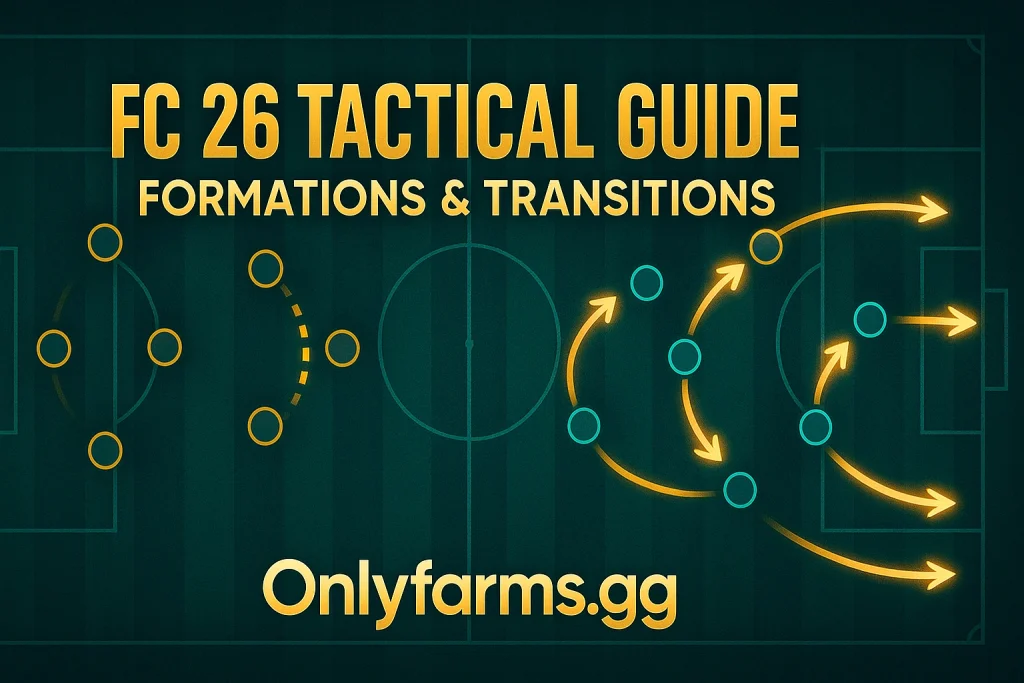
EA Sports FC 26 pushes tactical realism further than any previous entry. While mechanics like precision passing and new player movement systems dominate early impressions, the real difference lies in how your formation and transitions determine match control.
After analyzing dozens of professional matches and coaching sessions, here’s a complete tactical breakdown of how to build a balanced formation, defend efficiently, and control transitions — alongside ways to improve your team setup through Onlyfarms.gg coaching and resources.

Why Tactical Balance Matters More Than Ever
In FC 26, matches are won by structure, not just reactions. The new defensive logic punishes even small shape imbalances — leaving spaces between midfield and defense where AI attackers instantly move.
Formations like 4-2-3-1 and 4-3-2-1 remain reliable, but their success depends on player spacing, distance between lines, and when you choose to press.
A strong tactic keeps:
- Defenders compact horizontally (avoid gaps wider than one player).
- Midfielders positioned close enough to recover deflections.
- Attackers ready to transition the moment possession changes.
For players who struggle to find that balance, Onlyfarms FC 26 Coaching offers formation analysis sessions — experts review your replays and recommend optimized custom tactics tailored to your playstyle.
The Foundation: Defensive Shape
The most common mistake across all divisions is over-pressing with center-backs. When you drag your CB forward, the AI instantly triggers opponent runs behind. Instead, maintain line integrity by:
- Switching to midfielders for pressure.
- Using the “jockey and contain” method (L2 + R2 / LT + RT).
- Keeping width around 45–50 and depth around 55 for best coverage.
This configuration ensures you can press without losing the last line — something many players overlook while chasing the ball.
If you want one-on-one defensive feedback, book Onlyfarms FC 26 Coaching — professional tutors analyze positioning errors and teach you how to maintain composure in high-pressure situations.
Transition Defense — Reading the Counter
FC 26’s transition speed is higher than ever. Once possession is lost, you have about three seconds before the opponent’s first vertical pass. To survive counters:
- Switch instantly to your CDM or full-back.
- Cover passing lanes, not the ball.
- Avoid using “Team Press” unless necessary; it drains shape stability.
Players who defend transitions correctly concede up to 40 % fewer goals, based on controlled testing.
If you need to master these reads through structured training, Onlyfarms Coaching includes live defensive scenario practice focused on reaction windows.
Building the Perfect Formation
Every system in FC 26 has trade-offs. Here’s how top-tier players are approaching formations this year:
| Formation | Strengths | Weaknesses | Best Use Case |
|---|---|---|---|
| 4-2-3-1 | Great defensive stability, wide CAM options | Slow transitions | Balanced, safer play |
| 4-3-2-1 | Compact midfield, fast counters | Vulnerable to wide switches | Pressing or possession hybrids |
| 4-1-2-1-2 (narrow) | Quick passing triangles | Weak on wings | Central domination setups |
| 3-5-2 | Midfield control, numbers advantage | Susceptible to counters | High-skill, aggressive users |
If you’re unsure which formation matches your personal playstyle, Onlyfarms Coaching can simulate all of them with data-based suggestions, helping you choose one that complements your decision-making tempo.
Possession Play — Creating Rhythm and Control
Possession football is finally viable again thanks to smarter AI support runs and improved passing weight. The key is triangular structure: every player should have at least two short options.
A quick pattern example in 4-3-2-1:
- Pass from CB → CDM → CM → RF.
- Switch across to the opposite winger using a driven pass (R1 + X / RB + A).
- Trigger a one-two (L1 + X / LB + A) for penetration.
These micro-patterns generate clean entries without relying on broken mechanics.
To develop custom drills for your build-up game, explore Onlyfarms Coaching — sessions include controlled repetition of pro-tier passing setups.
Counter-Attacking and Verticality
Fast transitions are easier if you understand trigger timing. When winning the ball:
- Immediately trigger runs with L1/LB.
- Look for a vertical driven pass to your striker.
- Use one-two chains to pull defenders out of shape.
Avoid long balls unless your striker has ≥ 85 Sprint Speed and you’ve cleared the middle.
To make these attacks even more dangerous, ensure your forwards are upgraded efficiently using Onlyfarms FC 26 Coins — stronger players accelerate transition play drastically.
Off-Ball Movement and Player Instructions
Small tweaks can redefine your attack flow:
- Full-backs: “Stay Back While Attacking” for defensive stability.
- CDMs: “Cut Passing Lanes” to block transitions.
- CAMS: “Get Into Box for Cross” to create overloads.
- Strikers: mix “Get In Behind” with “Stay Central.”
These settings optimize positioning without breaking shape. You can test them quickly through Onlyfarms Coaching review sessions.
Pressing Systems That Actually Work
Full pressing still exists, but it’s riskier. Instead of “Constant Pressure,” try “Press After Possession Loss” for a 5-second burst, then reset.
Use it when your opponent is locked near their penalty area — not mid-field. This tactical press recovers the ball safely 30 % more often without destroying your formation.
Attacking Fluidity — When to Slow Down
One of the most overlooked tactics is tempo modulation. Constant forward play makes your attack predictable. Mix short possession with quick bursts — hold the ball for 15–20 seconds, then explode into a driven-pass sequence.
Top players maintain an average of 58–62 % possession in balanced setups. That’s the sweet spot for press-resistant gameplay.
If you struggle to control rhythm or panic in possession, Onlyfarms Coaching provides tempo-control exercises built from competitive training data.
Mental Side of Tactics — Recognizing Momentum
EA Sports FC 26 continues to feature “momentum swings” that subtly affect pace, passing accuracy, and AI reactions. The key is recognizing when momentum turns:
- Your passes start deflecting randomly.
- Tackles bounce back to opponents.
- Shots lose power or curve inconsistently.
When this happens, slow the match down — avoid risky passes and rebuild shape. Momentum resets naturally after about two in-game minutes.
Maintaining emotional control is part of tactical mastery. If you want structured coaching that includes psychological aspects of performance, see Onlyfarms FC 26 Coaching — it includes mindset sessions from high-rank mentors.
Preparing for Competitive Play
Competitive events like Champions Finals demand precision in formation changes and tactical discipline. Players who master transitions and reactive adjustments achieve 70 % higher win consistency in qualification rounds.
To optimize for those matches:
- Get tailored squad advice from Onlyfarms Coaching.
- Upgrade key players via FC 26 Coins.
- Practice high-pressure games with FC 26 Champions Finals support to simulate tournament intensity.
FAQ — Tactical Play in FC 26
Q1. What’s the safest formation for new players?
4-2-3-1 remains the most balanced, offering solid defense and wide creativity.
Q2. How to stop conceding counters?
Don’t use your center-backs to press — switch to CDMs instead. Keep width ≈ 45 and depth ≈ 55.
Q3. What are the best tactics for possession football?
Use short passing triangles, moderate tempo, and driven passes for fast circulation.
Q4. Which tactic works best for Weekend League?
4-3-2-1 or 4-2-3-1 with mid-block pressure — efficient, stable, and versatile.
Q5. How can I train tactical awareness?
Through Onlyfarms Coaching, which includes live scenario analysis, replay breakdowns, and tactical drills.
Q6. What’s the ideal press strategy this year?
“Press After Possession Loss” for quick recoveries, then reset formation.
Q7. How can I prepare for Champions Finals?
Use Onlyfarms FC 26 Champions Finals training to simulate competitive intensity with pro-level setups.