

Content:
- Introduction — The 3.27 Profit Meta That Still Works
- Core Concept: The Cloister Divination Scarab Stack Deck Farm
- Cost and Expected Profit
- Map Choice and Setup
- Atlas Tree Setup — Ritual + Beyond Core
- EXARCH vs. EATER — Which Is Better?
- Optional Add-Ons: Delirium and Map Corruption
- Example Loot and Profit Breakdown
- TL;DR Setup Recap
Introduction — The 3.27 Profit Meta That Still Works
Patch 3.27 changed a lot about Atlas passive trees and map modifiers — but one farming strategy remains almost untouched.
It’s consistent, fast, and easily scalable — still averaging around one Divine Orb every two maps.
If you’re tired of overcomplicated strat roulette, this is the stable Cloister Divination Scarab method, built around raw efficiency: farming Stacked Decks and basic currency duplication.
Even after recent nerfs, it remains one of the most reliable income streams for solo players or mid-budget setups.

Core Concept: The Cloister Divination Scarab Stack Deck Farm
The strategy revolves around running maps with five Divination Scarabs of the Cloister on your map device.
This guarantees massive Stacked Deck drops, easily enough to offset scarab costs and still turn profit every run.
Why Cloister Scarabs?
Each one significantly increases the chance of divination card drops, stacking multiplicatively with map quantity and ritual mechanics.
To maximize efficiency, fill all five scarab slots.
Running four is technically viable but less profitable — the additional deck volume from the fifth slot consistently outpaces its cost.
If you want to skip tedious bulk trading or stock up safely, you can always check PoE Divine Orbs or PoE Exalted Orbs sources to keep your mapping budget stable and ready.
Cost and Expected Profit
Let’s break down the math with current league prices:
- Cloister Scarab: ~12 Chaos each
- Full 5-scarab setup per map: 60 Chaos
- Average Stacked Decks per map: 60–80
- Market price of Stacked Decks: 1.5–2 Chaos each
That means:
- 60 Decks = 90–120 Chaos back per map
- ~50–80 Chaos profit each run
- Roughly 1 Divine Orb every 2 maps, depending on RNG and Stacked Deck price
Selling Stacked Decks for Divine conversions can yield even better margins, especially during early or mid-league phases.
Map Choice and Setup
Recommended Maps:
- Strand
- Underground River
- Mesa
- Jungle Valley
All are short, linear layouts ideal for fast clear speed and compact ritual placement.
Map Craft:
Use “Increased Quantity of Items Found in This Area” — it synergizes perfectly with Cloister Scarabs.
Skip Beyond/Legion/Delirium here unless you want to boost risk for marginal gains.
You can run 8-mod corrupted maps for maximum return — these consistently yield the best card density.
If you lack 8-mod maps, just Chisel → Alch → Vaaling random maps until you get them.
Players progressing alts or gearing new characters efficiently can save time by using PoE Leveling Gear setups to ensure smooth clear speed without needing meta-tier items.
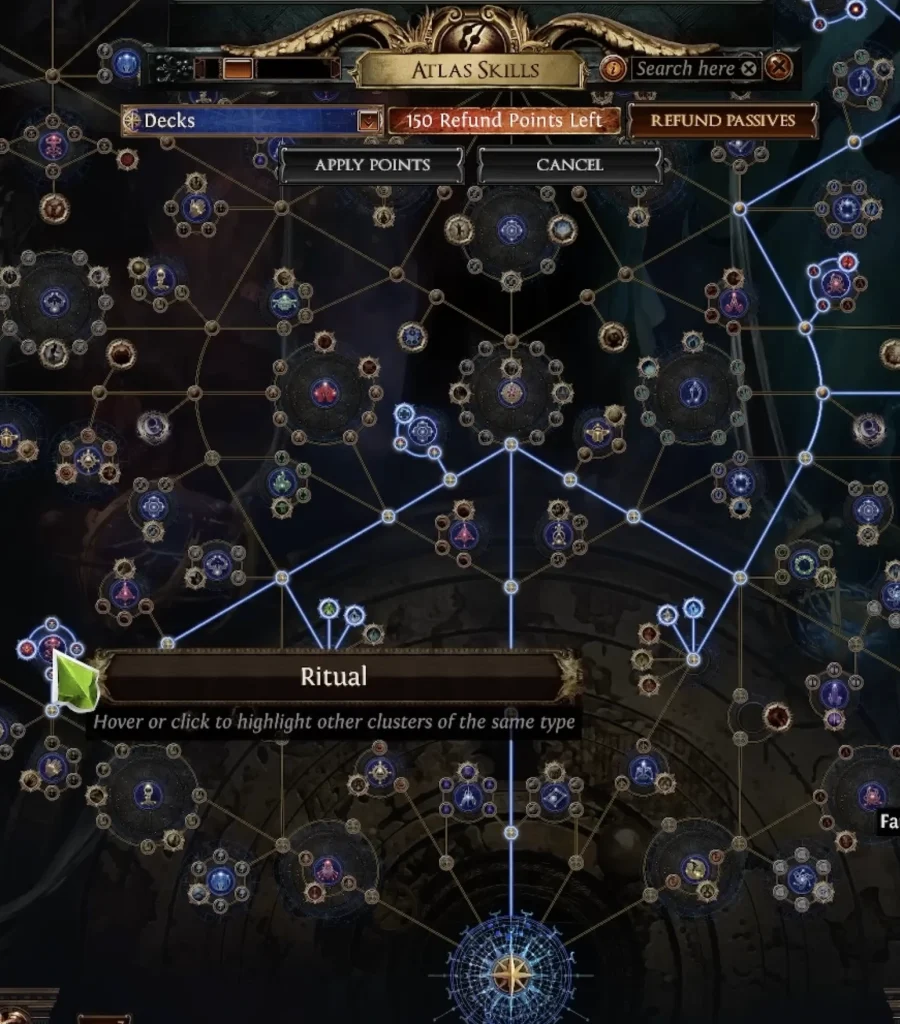
Atlas Tree Setup — Ritual + Beyond Core
The secret sauce of this strategy lies in your Atlas passive tree.
Ritual Nodes (Top-Left Cluster)
- Sacred Lands — allows resurrection of ritual monsters for extra drops.
- Aqua Devotion — ensures up to four rituals per map.
- 10% Chance to Contain Ritual Altars — stack these to guarantee consistency.
These nodes increase your Stack Deck yield dramatically since each ritual chest can drop multiple decks.
Blocking Other Content
To ensure rituals appear every map:
- Block Abyss, Expedition, Legion, Rogue Exiles, Delirium, and Ore Deposits.
- Leave Ultimatum, Blight, and Sacred Grove open (good side income from Scarabs and oils).
This keeps map mechanics clean and focused purely on your card drops.
Beyond Cluster
Pick up Thornvale, Pale Clarion, and Sands of Blood.
Beyond monsters add density, providing additional loot explosions and the chance for high-tier currency shards.
If you prefer unique drops or crafting dusts, you can swap Pale Clarion for Varashath.
Optional Nodes
- Chiseled Perfection → more map modifiers and monsters
- Remarkable Relics → small buff to scarab drop rates
- Singular Focus (optional) → if you want consistent favorite map drops
EXARCH vs. EATER — Which Is Better?
Both work, but for this setup, Exarch is slightly superior.
Here’s why:
- Exarch duplication altars can double your basic currency and Stacked Decks.
- The duplication chance isn’t constant, but even one trigger covers multiple maps’ worth of cost.
- Eater of Worlds provides solid baseline currency instead, so it’s safer early league.
Recommendation:
- Start with Exarch once you unlock the altar system.
- Swap to Eater if Exarch altar RNG feels inconsistent for your current session.
Optional Add-Ons: Delirium and Map Corruption
If you’re running non-corrupted maps, apply one Delirium Orb per map to add monster density and extra rewards.
This gives a moderate bump to both deck and chaos drops.
However, if you’re already running 8-mod corrupted maps, skip Delirium entirely — the raw quantity and ritual synergy already hit the efficiency cap.
Example Loot and Profit Breakdown
After running two maps:
- 147 Stacked Decks dropped
- Cost: 10 Scarabs × 12 Chaos = 120 Chaos
- Value: 147 Decks × 1.8 Chaos ≈ 265–270 Chaos
- Profit: ~150 Chaos (≈1 Divine Orb)
Add in small extras — raw Chaos drops, random Scarabs, or even a Tier 17 Fortress map, and profit easily climbs higher.
Even under poor RNG, you’ll rarely lose money.
The combination of ritual consistency and deck density makes this a league-stable farm with minimal volatility.
TL;DR Setup Recap
✅ Map Device: 5x Divination Scarabs of the Cloister
✅ Craft: Quantity of Items Found
✅ Atlas: Ritual + Beyond + Blocked Mechanics
✅ Influence: Exarch (for duplication altar)
✅ Maps: Strand, Underground River, Mesa, or Jungle Valley
✅ Mods: 8-mod if possible, always Chisel & Alch
✅ Average Profit: ~1 Divine / 2 maps
This setup thrives because it’s repeatable — even late in the league, when Divine prices stabilize, it keeps a strong chaos/hour ratio.
Final Thoughts
The Cloister Divination Scarab Ritual Strategy continues to deliver in 3.27.
It’s simple, accessible, and reliable — no rare sextant micro-management, no multi-mechanic chaos, just steady value through raw efficiency.
Whether you’re rebuilding your bank after rerolling a new build or just farming Stacked Decks for long-term flipping, this route remains one of the most dependable in Path of Exile.
And if you’re optimizing your Atlas strategy or adjusting your build for smoother clears, PoE Improve Build can help fine-tune your setup for damage balance and survivability — ensuring every map run stays fast and profitable.