

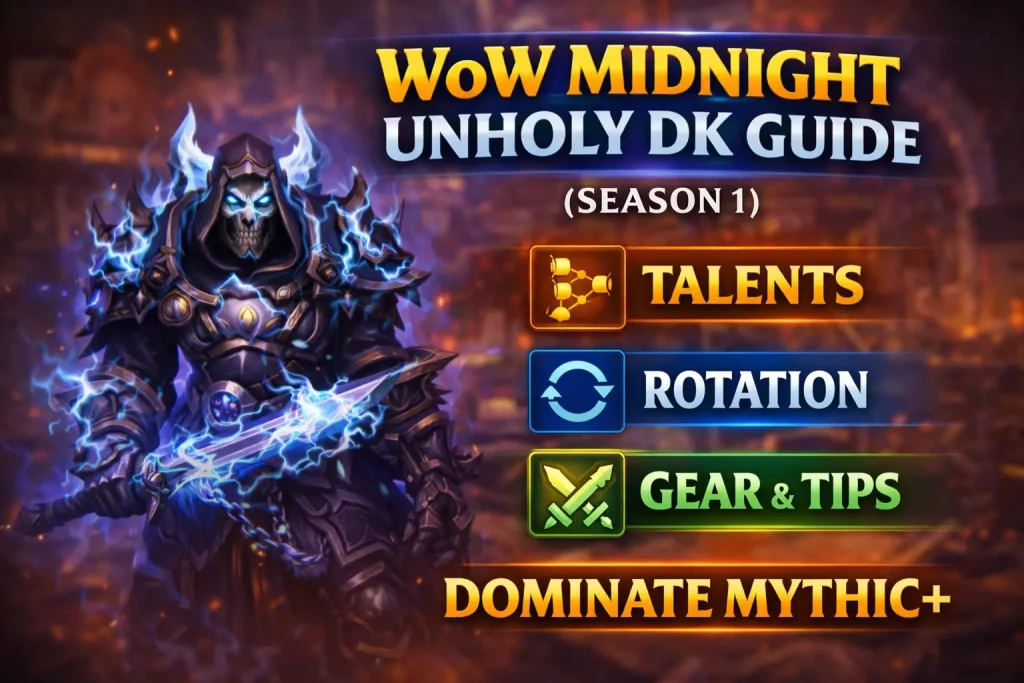
Content:
- Intro
- Why Unholy DK Feels So Good Right Now
- The Real Core of the Spec — Damage Through Systems, Not Buttons
- Dread Plague — The Hidden Engine of Your Damage
- Magi and Putrefy — Why Your AoE Feels So Explosive
- Rotation — Why It Feels “Messy” (And Why That’s Normal)
- Cooldowns — Simple Mechanics, Big Impact
- The Opener — Setting the Tone for the Entire Pull
- Gear — Why Scaling Matters More Than You Think
- The Real Skill Ceiling of Unholy DK
Intro
The Unholy Death Knight has quietly become one of the most dominant specs in WoW Midnight Mythic+ Season 1, and what makes it truly special isn’t just its damage output — it’s how effortlessly it blends survivability, consistency, and scaling into one complete package.
In a season where many classes struggle to stay alive in high keys, Unholy DK feels almost unfair. You’re not just another DPS relying on perfect execution — you’re a self-sufficient engine that can survive mistakes, stabilize pulls, and still top the meters.
But to unlock that full potential, you need more than just a talent import. You need to understand how the spec actually works — how its damage flows, how its systems interact, and where most players unknowingly lose efficiency.
Let’s break it all down.

Why Unholy DK Feels So Good Right Now
If you’ve played previous expansions, you probably remember Unholy as a spec that leaned heavily into AoE burst, sometimes at the expense of single-target performance. That’s no longer the case.
In Midnight, Unholy DK has evolved into something far more balanced.
You can enter a dungeon knowing that:
- You won’t fall behind on boss damage
- You won’t struggle in big pulls
- You won’t constantly need babysitting from your healer
That last point is especially important. In the current Mythic+ environment, healers are under enormous pressure, and every bit of self-sustain you bring makes the run smoother. Unholy DK’s ability to heal itself, absorb magic damage, and mitigate incoming threats means your healer can focus on the rest of the group — and that alone makes you incredibly valuable.
It’s not just about doing damage anymore. It’s about being reliable.
The Real Core of the Spec — Damage Through Systems, Not Buttons
What makes Unholy DK interesting is that your damage doesn’t come from a single button or burst window. It comes from a chain of interconnected systems working together.
At the center of it all is a loop:
- You apply diseases
- You build Festering stacks
- You convert those into damage
- That damage triggers additional effects
- Those effects feed back into your AoE
And when everything is working correctly, the spec feels like it’s snowballing — one ability feeding into another until the entire pull explodes.
The key is understanding that your damage isn’t just about pressing abilities on cooldown. It’s about maintaining this ecosystem.
Dread Plague — The Hidden Engine of Your Damage
If there’s one mechanic that separates good Unholy players from great ones, it’s how they manage Dread Plague.
At first glance, it just looks like another debuff. But in reality, it’s the backbone of your AoE scaling.
When enemies die with Dread Plague active, it spreads. That spread creates chain reactions. And those chain reactions are what generate massive burst in big pulls.
The mistake many players make is applying it randomly or ignoring target priority.
In reality, you want to be intentional.
You should be placing Dread Plague on targets that will die quickly. That might sound counterintuitive — most players instinctively target the strongest enemy — but the goal isn’t to keep it alive. The goal is to trigger the spread as often as possible.
When done correctly, you’ll see packs collapse in a cascade of explosions. When done poorly, your damage will feel flat and inconsistent.
Magi and Putrefy — Why Your AoE Feels So Explosive
Another layer of complexity comes from your interaction with Magi.
These aren’t just passive summons — they are one of your biggest damage contributors in Mythic+.
They are triggered through Putrefy, and Putrefy itself is tied directly to your overall rotation and procs. This means:
- The more efficiently you cycle your abilities
- The more consistently you maintain your debuffs
- The more often these Magi appear
And when they do, they don’t just deal damage — they cleave, amplifying your impact across multiple targets.
This is why Unholy DK scales so well in large pulls. It’s not linear scaling. It’s layered scaling, where each system amplifies the next.
Rotation — Why It Feels “Messy” (And Why That’s Normal)
One of the biggest adjustments for new Unholy players is accepting that the rotation doesn’t feel perfectly clean.
You will overcap resources.
You will have moments where everything is available.
You will feel like you’re “wasting” something.
That’s normal.
Unholy DK operates in a state of controlled overflow. You’re constantly generating more than you can spend, and the skill lies in prioritizing what matters most in each moment.
In AoE, your focus shifts toward Runic Power — because abilities like Epidemic and Necrotic Coil drive your damage in multi-target scenarios.
In single target, your focus shifts slightly toward rune spending, keeping your core rotation flowing.
But you’re never playing perfectly “efficiently” in the traditional sense. Instead, you’re making small decisions constantly, choosing what gives you the most value right now.
Cooldowns — Simple Mechanics, Big Impact
Unlike many specs, Unholy DK doesn’t overwhelm you with cooldown complexity.
You essentially have two major cooldowns:
- Army of the Dead
- Dark Transformation
And your goal is simple: keep them aligned.
Dark Transformation empowers your pets, and those pets are a significant part of your damage profile. If you start desyncing your cooldowns, you’re not just losing burst — you’re weakening your entire damage cycle.
The biggest mistake players make is holding Dark Transformation for too long. Even if the timing isn’t perfect, it’s better to use it consistently than to delay it and lose overall value across the dungeon.
The Opener — Setting the Tone for the Entire Pull
The way you start a pull has a massive impact on your performance.
You’re not just applying damage — you’re setting up your entire system.
You begin by applying your diseases, but timing matters. If the tank is still grouping mobs, applying them too early means you’ll waste potential spread. Waiting just a moment ensures better coverage.
From there, you build your stacks, activate your cooldowns, and transition into your rotation — but the important part is that everything flows from that initial setup.
A clean opener leads to strong momentum. A sloppy one forces you to play catch-up.
Gear — Why Scaling Matters More Than You Think
Unholy DK benefits heavily from scaling stats like Critical Strike and Mastery, both of which enhance your core systems rather than just raw numbers.
But gearing in Midnight isn’t just about stats — it’s about access.
Crafted items, trinkets, enchants — all of these play a role in maximizing your output, especially early in the season when upgrades are scarce.
Because at the end of the day, better gear doesn’t just mean higher damage — it means more room for error, more survivability, and more successful runs.
The Real Skill Ceiling of Unholy DK
What makes Unholy DK so satisfying is that it rewards awareness more than mechanics.
You don’t need perfect APM.
You don’t need insane reaction speed.
But you do need:
- Good target selection
- Awareness of pull size
- Understanding of when to burst vs hold
- Control over your debuffs
And that’s where the real skill lies.
Final Thoughts — Is It Worth Playing?
Absolutely.
Unholy DK isn’t just strong — it’s one of the most complete specs in WoW Midnight right now.
It gives you:
- Stability in high keys
- Flexibility in different scenarios
- Strong solo survivability
- High damage ceiling
And most importantly, it gives you consistency — something that’s incredibly valuable in a season where surviving the dungeon is often more important than rushing it.